There is a specific kind of silence that follows an online application, and it has got worse in a way that is measurable.
You submit. You get an automated acknowledgement within seconds, which is somehow more insulting than nothing. Then either a rejection arrives so fast that no human could plausibly have opened the file, or nothing arrives at all and you are left to work out which of those two things happened.
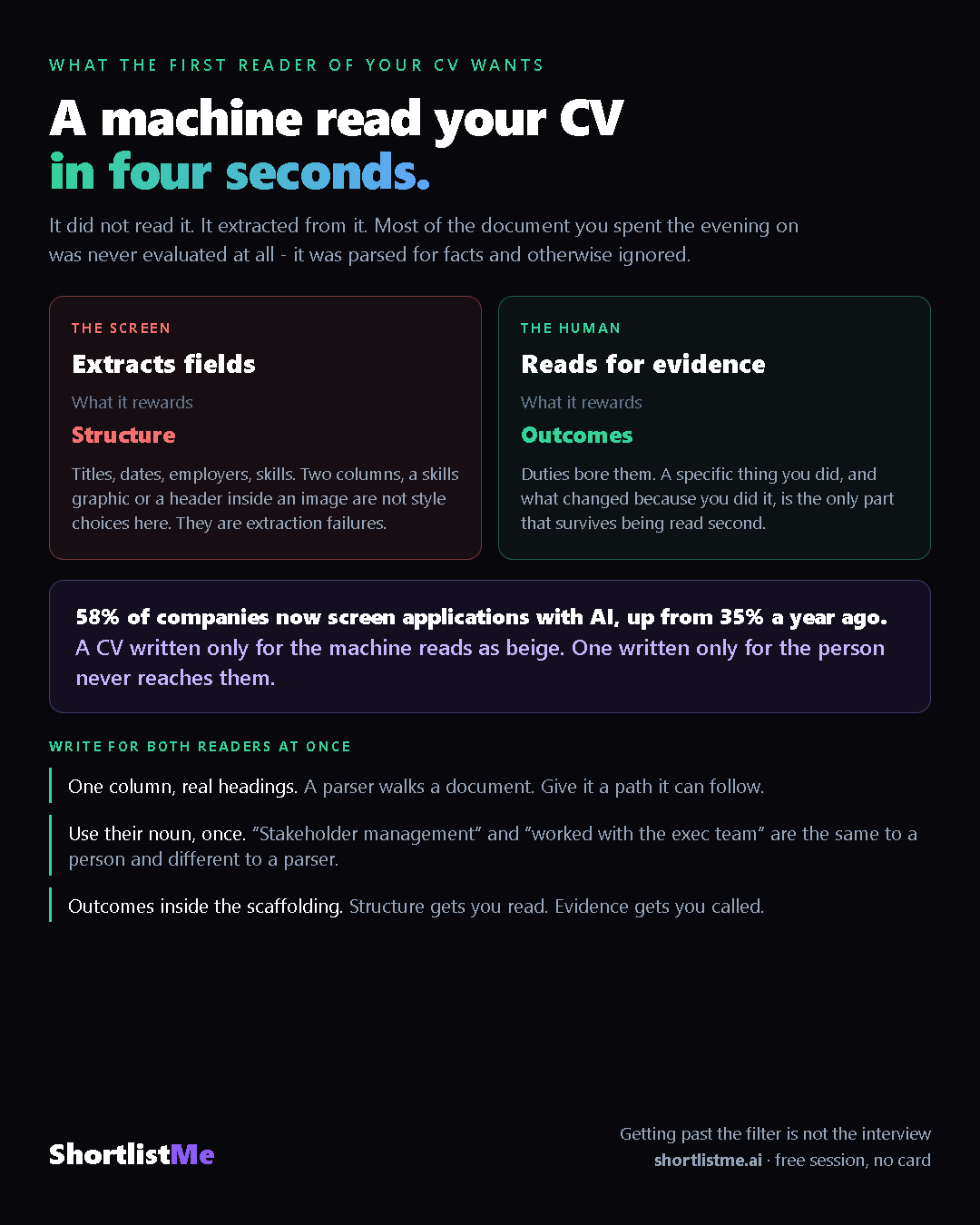
Eighty-seven per cent of hiring managers now say their company uses AI somewhere in recruitment, and fifty-eight per cent use it specifically to screen CVs — up from thirty-five per cent the year before. That is not a slow drift. That is the first reader of your CV changing, in about eighteen months, from a person into a process.
The thing that makes this genuinely disorienting
It is not that machines are reading. It is that you cannot tell which thing happened to you.
When a human rejects you, the rejection carries information, even if you never see it. Somebody looked, formed a view, and moved on. When a filter rejects you, there is no view. There is a threshold, and you were on the wrong side of it for a reason that may have nothing to do with your suitability — a job title phrased differently, a date format the parser did not recognise, a skill named the way your last employer named it rather than the way this one does.
And when the role was never real, none of it happened at all.
Three completely different failures, one identical silence. That is what makes the modern job search so hard to learn from: the feedback signal has been flattened into a single note.
What an automated screen actually does
Worth being precise, because the folklore has run ahead of the reality.
A screen does not "read" in any sense you would recognise. It extracts. It pulls structured fields out of an unstructured document — titles, dates, employers, skills, education — then scores that structure against a requisition. Most of your CV, the part you spent the evening on, is not being evaluated. It is being parsed for extractable facts and otherwise ignored.
This has two consequences that most CV advice gets backwards.
Formatting matters more than prose. A two-column layout, a skills graphic, a header inside an image, an unusual date format — these are not stylistic choices at the screening stage. They are extraction failures. The most beautifully written CV in the world scores zero against a requirement it stated inside a graphic.
Naming matters more than describing. If the posting asks for "stakeholder management" and your CV says "worked closely with the exec team", a human reads those as the same thing and a parser does not. You are not being asked to stuff keywords. You are being asked to use their noun, once, somewhere a parser will find it.
What the human on the other side still wants
Here it gets awkward, because the two readers want opposite things.
The screen wants structure, standard vocabulary and extractable facts. The human — who reads your CV second, if at all — wants evidence that you did something specific and it worked. Duties bore them. Outcomes do not.
A CV optimised only for the machine reads as beige and gets discarded by the person. A CV optimised only for the person never reaches them.
The resolution is less clever than it sounds: write the outcomes, in their vocabulary, in a layout a parser can walk. One column. Real section headings. Job titles that match the market's language rather than your employer's internal one. Skills named plainly somewhere they can be extracted. And then, inside all that scaffolding, the sentences that actually make a case.
The four seconds are not the interview
This is the part worth holding onto.
Every hour you spend fighting the filter buys you the right to be assessed. It does not do any of the assessing. The screen cannot tell whether you can explain your own work, whether you fall apart under a follow-up question, or whether you talk for four minutes when ninety seconds would have done.
It is entirely possible to become very good at getting past filters and remain exactly as unprepared as before for the conversation on the other side. That is the trap of an application-heavy job search: it is measurable, it feels productive, and it optimises the wrong skill.
Get the CV parseable. Use their words. Put the outcomes where a person will find them once the machine has waved you through.
Then spend the rest of your preparation on the part a machine was never going to test.