Every interview you will ever sit opens with some version of it. "So, tell me about yourself." "Walk me through your background." "Give me the short version."
People treat it as the warm-up. The bit before the real questions. It isn't. It is the only question you are guaranteed to be asked, it is the one you have the most control over, and it is being scored before you have registered that scoring has started.
I have watched more people lose an interview in those ninety seconds than in any technical round.
Why it is harder than it looks
The question is unbounded. Every other question has edges — tell me about a time you handled conflict has a shape you can find. "Tell me about yourself" has no shape at all, and an unbounded question in a high-pressure room is the worst possible combination.
So people default to the only structure they own: the CV. They start at university and walk forwards, or start at the current job and walk backwards, and either way they are four minutes in and reciting a document the interviewer already has open in front of them.
Two things go wrong at once. You have spent your best ninety seconds telling them what they already know, and you have signalled that you have not thought about why you are in this room — because if you had, you would have led with it.
What the question is actually asking
It is not asking for your history. It is asking three things at once.
Can you organise a thought under pressure? Every interviewer runs this check whether they know it or not. A rambling answer here predicts a rambling answer everywhere.
Do you understand what this job is? A good answer is different for every role you apply to. If yours would work unchanged for any employer, it is not an answer, it is a recording.
Are you going to be exhausting to work with? Nobody says this out loud. But four minutes of unstructured autobiography answers it anyway.
The shape that works
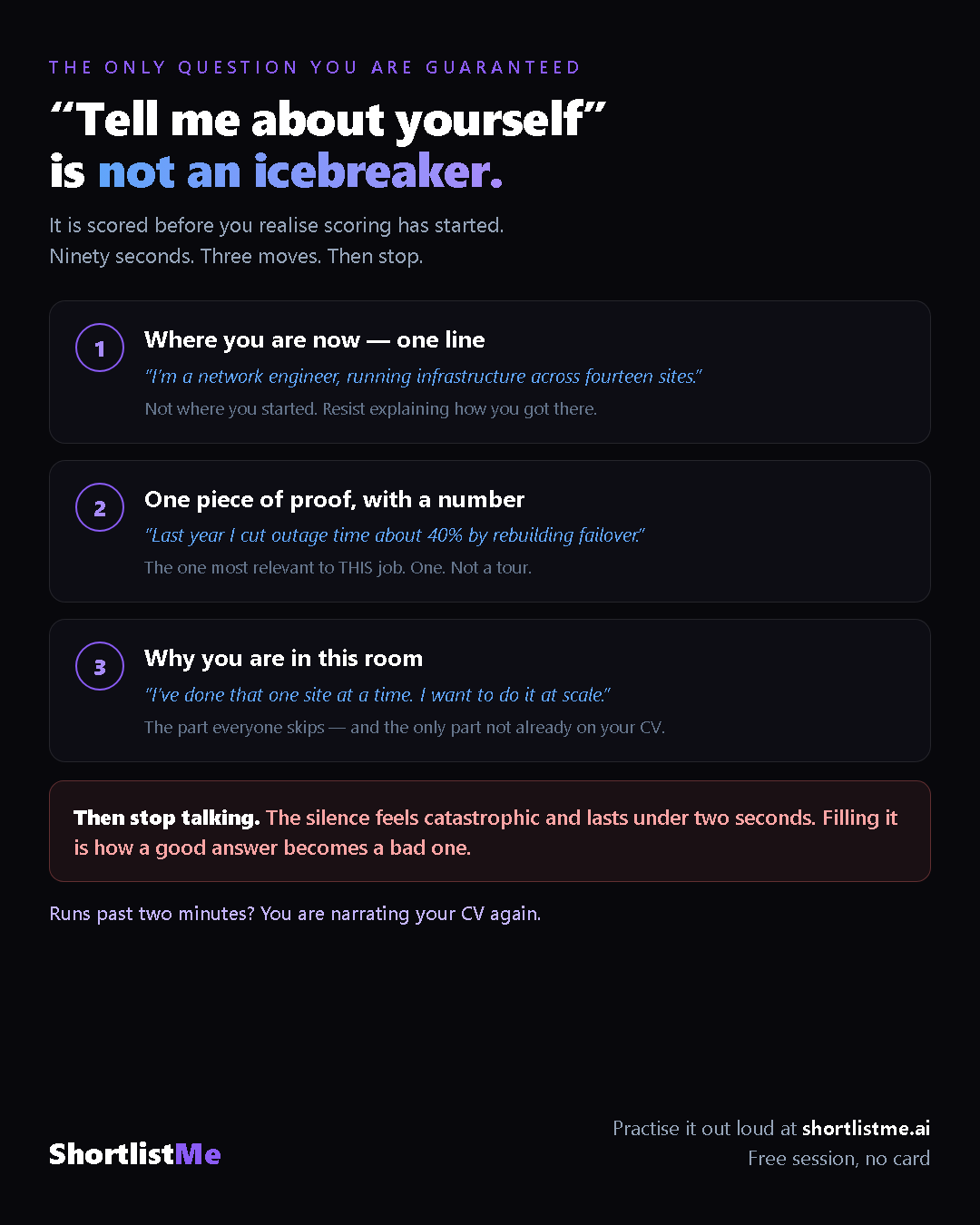
Ninety seconds. Three moves.
Where you are now, in one line. Not where you started. "I'm a network engineer, currently running infrastructure across fourteen sites at a logistics company." That is the whole opening. Resist the urge to explain how you got there.
One piece of proof, with a number in it. Pick the single achievement most relevant to this job and give it a result. "Last year I cut our outage time by about forty percent by rebuilding how we handle failover." One. Not a tour.
Why you are in this room. The part almost everyone skips, and the part that actually separates you from the other four candidates. "I've been doing that one site at a time and I want to do it at scale, which is why this role caught my attention." Now the interviewer knows something they could not have got from your CV.
Then stop talking. The silence after ninety seconds feels catastrophic and lasts under two seconds in reality. Filling it is how a good answer becomes a bad one.
The rehearsal problem
Here is what makes this hard to fix by reading about it.
You now know the structure. You could write yours out in ten minutes. And you will still fumble it in the room — because knowing the shape of an answer and being able to produce it out loud under pressure are different skills, and only one of them improves by reading.
The gap between the answer in your head and the answer in the room is the entire problem. You can only find it by hearing yourself, which means saying it out loud, badly, several times, somewhere that does not count. Most people never do that even once before the interview that decides their year.
That is the specific thing we built ShortlistMe for. A session opens where a real interview opens — an introduction, then your background, then role questions, then behavioural ones — and it waits while you think instead of cutting in the moment you pause. Afterwards you get a scored report showing which answers actually landed, in your own words rather than a template's.
It is free to start: one session and two CV analyses, no card.
What it will not do is get you the job. Nobody can promise that. What it can do is make sure the first time you say those ninety seconds out loud is not in the room that counts.
If you do nothing else
Write your three moves down. Say them out loud, standing up, twice. Time it.
If it runs past two minutes, you are narrating your CV again. Cut back to the one line, the one number, and the one reason you are there.
— Muhammad Waqar, Melbourne