You took the afternoon off. You ironed the shirt. You read their annual report on the train and found something intelligent to say about their expansion into Europe.
Round one went well. Round two went well. Round three was with someone whose job title you still do not entirely understand, and it also went well. Then round four, and then nothing — not a rejection, not a delay, just the particular silence of an inbox that has stopped mentioning you.
You have spent the weeks since going back over your answers. Which one was it. The gap. The salary question. The moment you said "we" when you should have said "I".
Here is a possibility worth sitting with before you rewrite your CV again: there was never a job.
Ghost jobs are not a conspiracy theory. They are a disclosed practice.
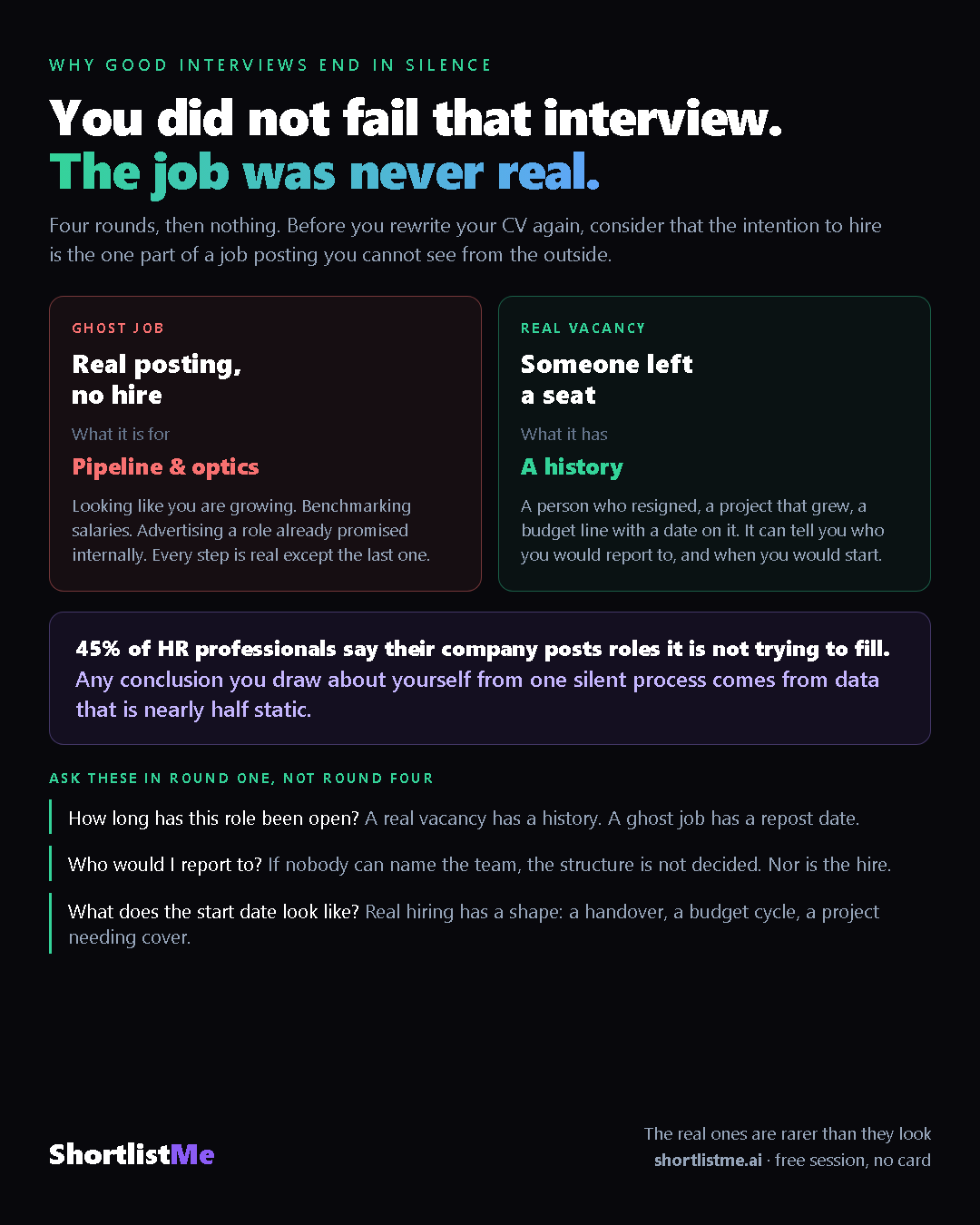
A LiveCareer survey of more than nine hundred HR professionals found that forty-five per cent said their organisation posts roles regularly that it is not actively trying to fill. Not once. Regularly.
The reasons are mundane, which is what makes them so hard to spot from outside.
A company wants to look like it is growing, because customers and investors read a careers page as a health chart. A manager wants a pipeline ready for a headcount that has not been approved yet. A team is required to advertise externally for a role that has already been promised internally. Somebody is benchmarking salaries and needs applicants to benchmark against.
None of that requires anyone to lie to you. The posting is real. The interviews are real. The intention to hire is the part that is missing, and it is the only part you cannot see.
What this does to a job search is worse than the wasted time
The hours are recoverable. The damage is to your calibration.
Every process that ends in silence teaches you something, and if the process was never real, everything it teaches you is false. You conclude your answers are weak. You conclude your experience does not land. You start hedging, shortening, apologising — adjusting a performance that was never being scored.
Career advisers describe this as having moved past ordinary job-search fatigue into something more corrosive: a systemic cynicism, where candidates stop believing the process has any relationship to outcomes at all. That is a rational response to an environment that has stopped giving honest signals. It is also the thing most likely to make you worse at the interviews that are real.
The signals that separate a real vacancy from a ghost
None of these is conclusive alone. Together they are usually enough.
Ask how long the role has been open. A real vacancy has a history — a person who left, a project that grew. A ghost job has a repost date and a vague answer. This one question costs you nothing and is the most efficient thing you can ask.
Ask who you would report to, by name and role. Real vacancies sit inside a structure. If nobody can tell you which team you would join, the structure has not been decided, and neither has the hire.
Ask what the start date looks like. Real hiring has a shape: a budget cycle, a handover, a project that needs covering by November. Vague timelines are the most reliable tell there is.
Watch for the posting that never closes. A role live for four months, taken down and reposted with identical text, is a pipeline, not a vacancy.
Notice who is interviewing you. Four rounds with people who cannot describe the day-to-day is a company exploring an idea, not filling a seat.
What to do with this
Not despair, and not paranoia. Triage.
Ask the how-long-has-this-been-open question early — round one, not round four. Keep applying while you interview, no matter how well it went, because a process that felt promising tells you nothing about whether it was ever going to conclude. And when one goes silent, resist attributing it to yourself by default. Sometimes the answer is that you were the second choice. Sometimes it is that there was no first choice either.
The market has roughly forty-five per cent noise in it by HR's own account. Any conclusion you draw about yourself from a single silent process is drawn from data that is nearly half static.
The part you can still control
The frustrating truth is that ghost jobs make preparation more valuable, not less.
If a meaningful share of the processes you enter were never going to hire anyone, then the real ones are rarer than they look, and each one carries more weight. You do not get many. The one that is genuine — where the team exists, the budget is signed, the manager is impatient to fill it — is the one where fumbling the salary question or running four minutes long actually costs you something.
You cannot audit their intentions. You can be the candidate who does not waste the real one.
That is what practice is for. Not polish, and not confidence — just making sure that when a genuine opportunity finally turns up, the version of you that walks in is the one you meant to send.