There is a moment, about fifty minutes in, when your shoulders drop. The hard questions are done. You survived. Then they say it:
"Great — do you have any questions for us?"
And something in your head files this under admin. The interview is over, this is the wind-down, be polite and get out.
It isn't over. You are still in the room, they are still forming an opinion, and this is the only segment of the entire hour where you choose the subject. Everything before it was their agenda. This part is yours.
Most people hand it back unopened.
What "no, I think you covered everything" actually communicates
It is meant as courtesy. It rarely lands that way.
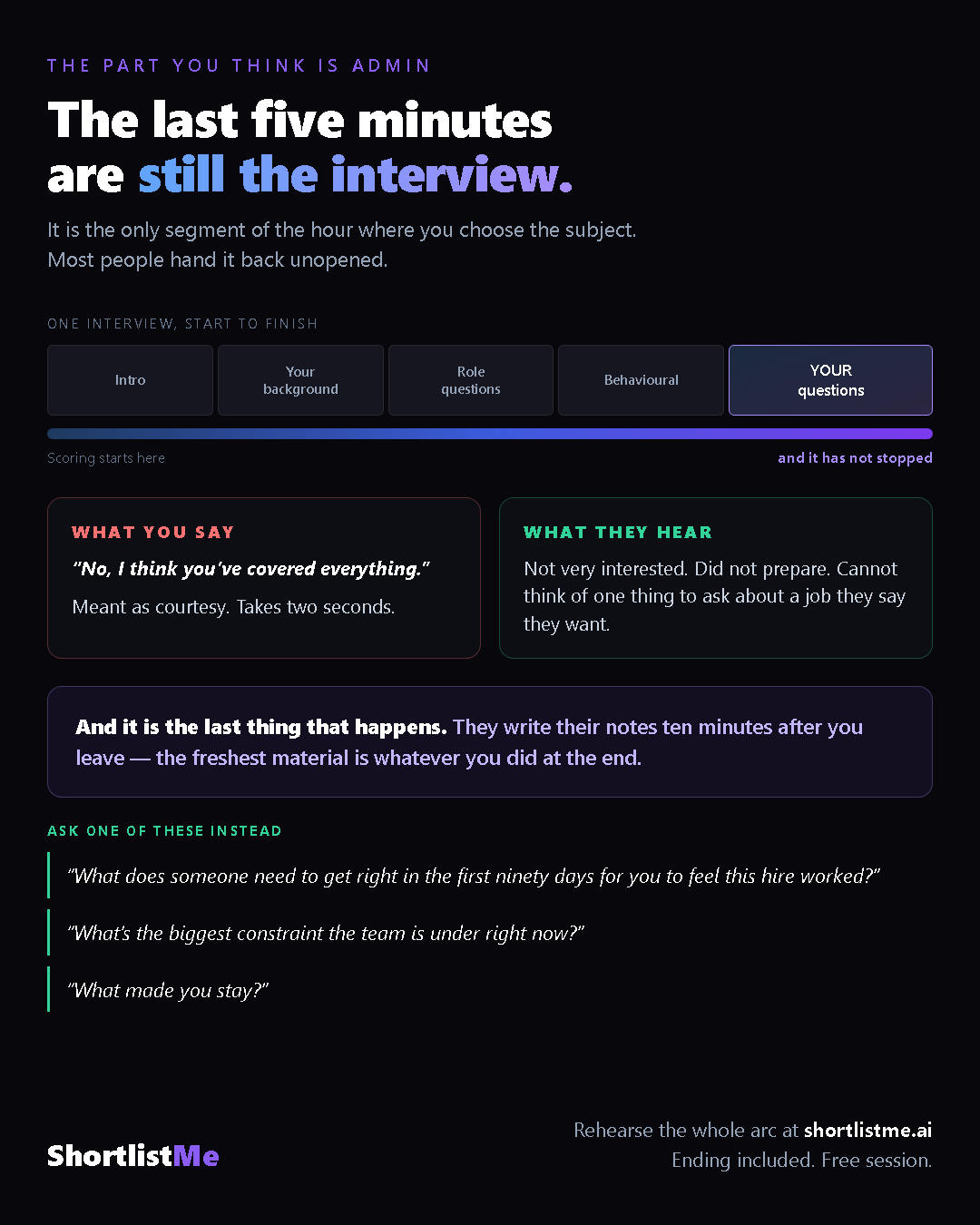
From the other side of the table it reads as one of three things: you are not very interested, you did not prepare, or you cannot think of anything to ask about a job you supposedly want. None of those is what you meant, and all of them are what gets remembered — because it is the last thing that happens.
The recency effect is not a trick, it is just how memory works. The interviewer writes their notes in the ten minutes after you leave, and the freshest material is whatever you did at the end.
The three tiers of question
Not all questions help. There is a ladder, and most people never leave the bottom rung.
Tier one — the ones you could have Googled. What does the team work on? How big is the company? What's the tech stack? These are on the careers page. Asking them proves you did not read it.
Tier two — the ones about you. What's the salary? How much holiday? Is there remote flexibility? All legitimate, all things you must eventually know, and all wrong for this moment. They are negotiation questions, and negotiation happens after they want you.
Tier three — the ones that show judgement. These are about the work, the problem, or the standard. They tell the interviewer how you think, which is the entire thing they have been trying to assess for an hour.
Examples that live on the third rung:
- "What does someone need to get right in the first ninety days for you to feel this hire worked?"
- "What's the thing about this team that people only find out once they've joined?"
- "Which part of this role is hardest to hire for, and why?"
- "What would you want fixed in six months that isn't fixed today?"
Each one does the same quiet work: it makes the interviewer think, it gets you information you genuinely need, and it shows you are already reasoning about the job rather than about getting the job.
Ask about the problem, not the perks
The single most useful reframe: every good closing question is about the work, not about your comfort.
"What's the biggest constraint the team is under right now?" beats "what's the culture like?" — because the first has an answer only an insider can give, and the second produces a sentence from the recruiting brochure.
You also learn something real. A candidate who asks about constraints hears whether the team is under-resourced, whether the last person burned out, whether the roadmap is fantasy. That is information you want before you sign anything.
Two things worth doing
Write four, ask two. Prepare four, so that when two get answered during the interview — and they will — you are not left empty. Nothing undoes an hour of good work faster than "you've actually covered them all" delivered with visible relief.
Ask one question about them personally. "What made you stay?" is disarming, human, and almost nobody asks it. You are talking to someone who chose this company, possibly years ago. They will usually tell you something honest, and they will remember that you were curious about it.
The bit that has to be practised
You can read this list, agree with all of it, and still say "no, I think you've covered everything" — because by minute fifty you are tired, relieved, and running on autopilot.
That is a rehearsal problem, not a knowledge problem. The closing questions are the last thing people practise and the first thing they drop, which is exactly backwards given they are the last thing anyone remembers.
A ShortlistMe session runs the full arc — introduction, background, role questions, behavioural questions, then your questions for the interviewer — so the ending gets rehearsed along with everything else, instead of being the part you have only ever done for real.
Free to start: one session and two CV analyses, no card.
It will not get you the job. Nobody can promise that. But the last five minutes are yours, and it is a strange thing to give them away.
— Muhammad Waqar, Melbourne