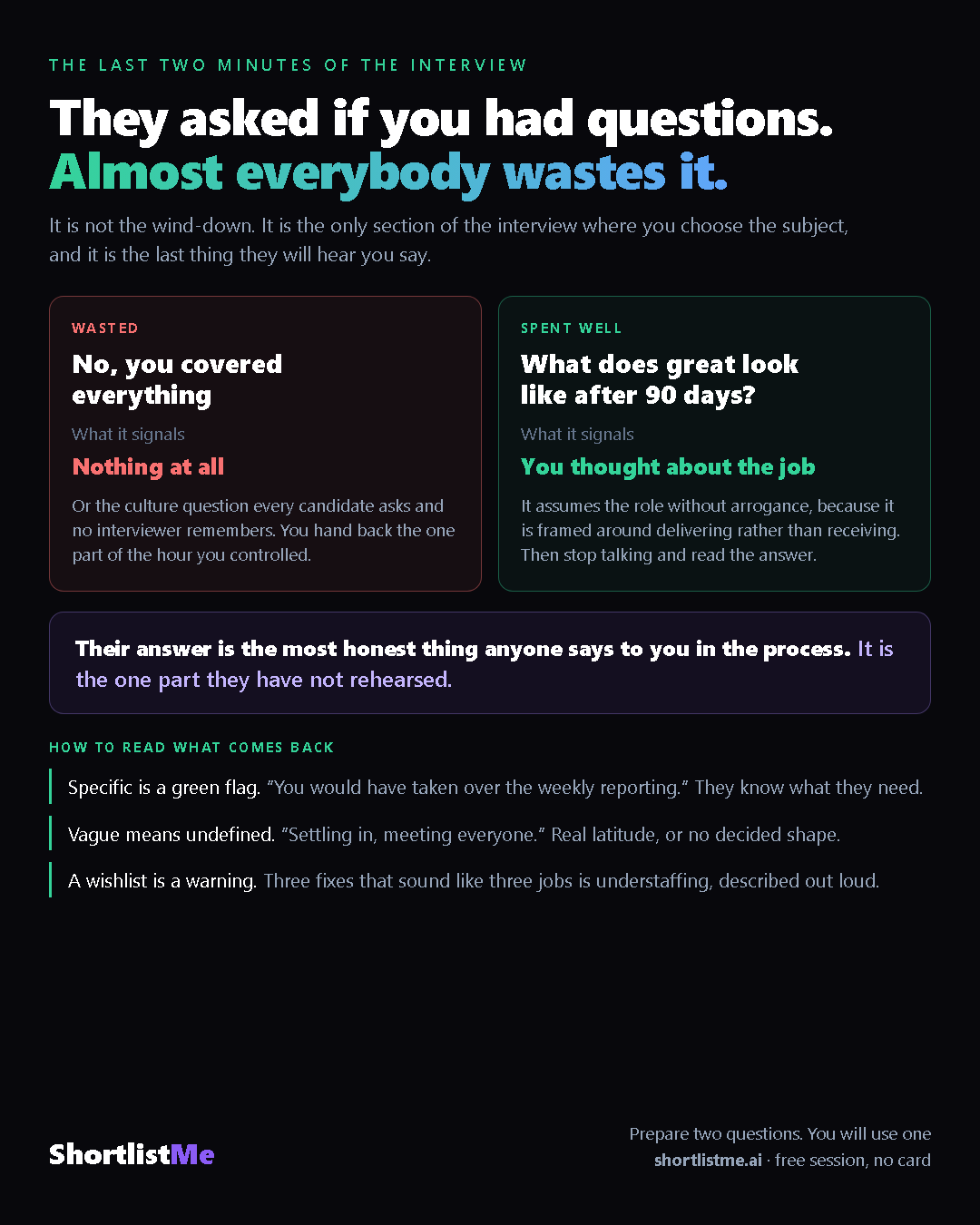
"Any questions for us?"
It arrives when you are tired, slightly over-caffeinated, and mostly relieved that the difficult part is done. That is the problem, because it is not the wind-down. It is the last thing they will hear you say, and the only section of the interview where you choose the subject.
Most people give it away. "No, I think you've covered everything." Or the safe one about culture. Or the one about training and development that every candidate asks and no interviewer has ever remembered.
There is a better use for those two minutes, and it is not a trick.
What the question is actually testing
Interviewers are not being polite. They are running one last check, and it is a good one: do you understand what this job is, or have you been auditioning for a job-shaped abstraction?
Someone who has genuinely thought about the role asks about the role. Someone who has thought about getting the role asks about progression, perks and process. The gap between those two is visible from across a table, and it is the last impression you leave.
The question
"What does great look like in this role after ninety days?"
Ask it, then stop talking.
It works for reasons that compound. It assumes you have the job, without arrogance, because it is framed entirely around delivering rather than receiving. It asks them to describe success concretely, which most managers have never been made to articulate out loud — and watching someone construct that answer live tells you an enormous amount about whether the role is understood by the people hiring for it.
And it changes what you are in the room. For the whole interview you have been the person being assessed. For the length of that answer you are the person the work is being explained to. That shift is small, and it is the thing people remember.
What their answer tells you
This is the part candidates underuse. You asked a diagnostic question — now read the diagnosis.
A specific answer is a green flag. "In ninety days you'd have taken over the weekly reporting, and we'd have stopped doing it manually." That is a team that knows what it needs. It is also a gift: you now know exactly what to reference in your follow-up email.
A vague answer is information too. "Just getting up to speed, settling in, meeting everyone." Said warmly, this often means the role is genuinely new and nobody has decided its shape. Not automatically bad — it can mean real latitude — but you should know you are being hired into an undefined space, and negotiate accordingly.
A wishlist is a warning. If ninety days involves fixing three things that sound like three different jobs, you have learned something the posting did not tell you. "Fast-paced, everyone wears many hats" said out loud usually means understaffed.
The second question, if you get one
"How long has this role been open?"
Less elegant, more useful. A real vacancy has a history — someone left, something grew. A long-open role has a story, and the story is always worth hearing: the last two people did not work out, the budget kept moving, the requirements changed three times.
Nobody is offended by this question. It is a reasonable thing for a professional to want to know, and a team with nothing to hide answers it easily. The hesitation before the answer is the answer.
What not to ask
Not because these are forbidden, but because they spend the slot badly.
Anything answered on the careers page — you are showing you did not read it. Salary and holiday at first stage, when they have not yet decided they want you. "Do you have any concerns about my application?", which sounds bold and mostly invites the interviewer to articulate a doubt they had not finished forming. And the open-ended culture question, which produces the same non-answer in every company on earth.
Prepare two, not five
You will not get through five. You will get through one, maybe two, and you will be tired.
So pick two and know them cold — the ninety-day question, and one more shaped by whatever you actually want to know about this specific team. Write them at the top of your notes, not the bottom, because that is where you will be looking when the moment arrives.
Then ask, and listen properly rather than waiting for your turn to speak. The answer is usually the most honest thing anyone says to you in the entire process. It is the one part they have not rehearsed.