You know the email before you open it.
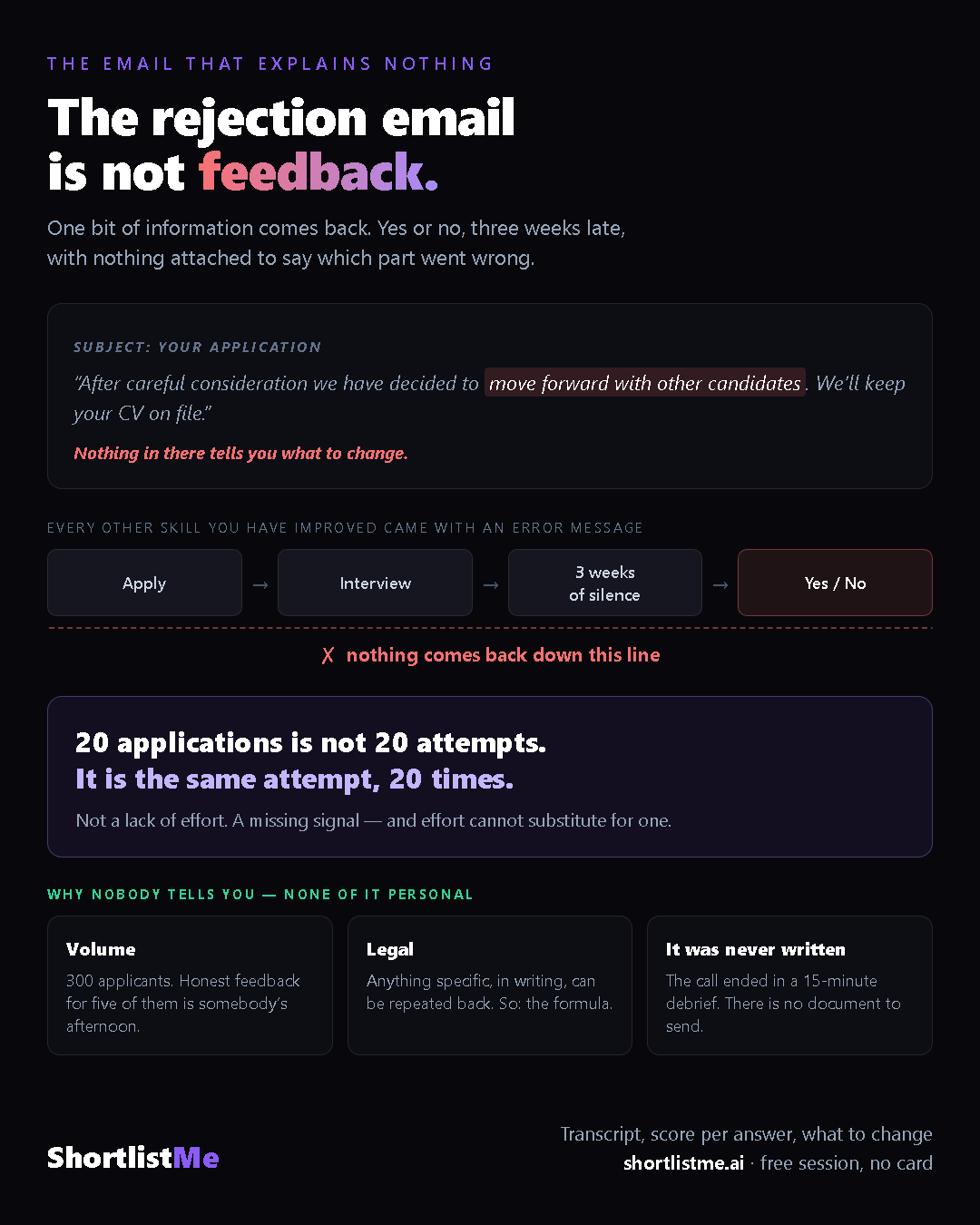
"Thank you for taking the time to speak with us. After careful consideration we have decided to move forward with other candidates. We'll keep your CV on file."
You read it twice, looking for the sentence that tells you what actually happened. It isn't there. It was never going to be there. And then you do the only thing available to you: you guess.
Nobody is withholding anything
It feels personal. It almost never is. There are three ordinary reasons the email says nothing, and none of them are about you.
Volume. Three hundred applications, twelve phone screens, five interviews, one hire. Writing five honest, specific, defensible pieces of feedback is most of an afternoon for someone who has already moved on to the next requisition.
Legal exposure. Anything specific, in writing, can be repeated back — to a lawyer, to a tribunal, on LinkedIn. Companies are advised, entirely sensibly, to say nothing beyond the formula. The formula is the advice working as intended.
Nothing was written down. This is the one people underestimate. The decision often happens out loud, in a fifteen-minute debrief, as a sentence like "I just wasn't confident about the delivery." It never becomes a record. There is no document to send you. The feedback you are waiting for does not exist in a form anyone could forward.
What that does to everything you do next
Think about any other skill you have ever got better at.
Code that will not compile tells you the line. A wrong answer comes back marked wrong. A driving instructor says "again, and this time check your mirror first." Every one of those is a loop: you act, something tells you what happened, you adjust.
Interviewing has no loop. You perform for an hour, and three weeks later one bit of information comes back. Yes or no. Nothing attached.
You cannot improve on one bit. Which leads to the thing worth sitting with:
Twenty applications is not twenty attempts. It is the same attempt, twenty times.
That is not a lack of effort. It is a missing signal, and effort cannot substitute for it.
The silent variable
When there is no signal, people fix whatever is visible. What is visible is the CV.
So it gets rewritten. Fifth version. New layout, tighter bullets, a different font because someone on Reddit said the old one looked dated. Genuinely useful work, sometimes. But if you got the interview, the CV already did its job — and you are now editing the one part of the process that already worked.
Meanwhile the thing that actually decided it happened about three minutes into the call. A four-minute answer to "tell me about yourself" that wandered into your degree. A story with no result at the end of it. A follow-up question you heard as an accusation and answered defensively. A pause you filled instead of letting sit.
You cannot see any of that, because you were inside it. Nobody who was in the room will tell you. So the visible thing keeps getting polished and the deciding thing stays untouched, application after application.
It is debugging with no error message. You change something, ship it, wait three weeks, and learn nothing.
Three questions the rejection would answer if it could
You cannot make them talk. You can, however, work out roughly where you are losing it — because the shape of your own results is information, and it is free.
Applications, but almost no interviews. The paper is the problem. Targeting, CV, the match between what you wrote and what they asked for.
Interviews, but no offers. The paper is fine — it got you in the room. The room is the problem, and no amount of CV editing will touch it.
Final rounds, but no offers. You are competitive. At this stage the deltas are small and some of them are genuinely not yours: an internal candidate, a budget pulled, someone who had done the exact job before.
That third case is real and more common than anyone admits, and it is the one to stop taking personally. But you cannot tell which of the three you are in without looking at the ratio — and most people never look, because each rejection gets processed on its own, as a verdict, rather than as a data point in a series.
Count them. It is the closest thing to feedback this process will ever hand you.
Building the loop yourself
If the signal will not come from them, it has to be manufactured. Four things that work, in rough order of how uncomfortable they are:
Say it out loud and record it. Not in your head. The answer in your head is fluent, ordered and about ninety seconds long. The one that comes out of your mouth is none of those things, and the gap between them is the entire problem.
Play it back tomorrow, not today. Same-day, you hear what you meant. A day later, you hear what you said.
Read the transcript instead of listening to it. Listening forgives — your own voice sounds reasonable to you. Reading does not. Rambling looks like rambling on the page, and you will find the word you say forty times.
Score against something fixed. Not "was that good." Did I answer the question they actually asked? Was there a result at the end? How long did I talk for? Fixed questions produce comparable answers; vague ones produce a mood.
And one more, which matters more than any of them: get somebody to ask you a follow-up. The first answer is rarely where it goes wrong. It goes wrong at "can you tell me more about your specific role in that?" — the moment the prepared paragraph runs out and you have to think in front of someone.
What we built, plainly
This is the gap ShortlistMe exists in. A session is a voice interview on your actual target role, and at the end you get the thing the employer will never send you: the full transcript, a score on each answer, and a specific note on what to change — including the follow-ups, because that is where it usually turns.
It is not a verdict, and it is not a prediction. It is the error message. What you do with it is the part that has always been yours.
Free to start: one session and two CV analyses, no card.
It will not get you the job. Nobody can promise that, and anyone who does is selling you something else. But you should not have to run the same hour twenty times, blind, hoping the twenty-first goes differently.
The rejection email is not withheld feedback. Most of the time there is no feedback to withhold — nobody ever wrote it down. Which means the only person who can build you a loop is you.
— Muhammad Waqar, Melbourne