Twenty minutes in, the tone changes slightly. They glance at their notes and say it almost apologetically.
"So — what are you looking for, compensation-wise?"
And something happens to otherwise composed people. They laugh a little. They say they are flexible. They ask what the band is, get told it depends on experience, and then say a number anyway, in a voice that lifts at the end like a question.
The internet will tell you this moment is a game of chicken about who says a number first. That framing is why it goes badly. It turns a scoping question into a test of nerve, and nerve is not what is being measured.
The question arrives before you have what you need to answer it
Notice when it comes. Usually the first call, often before you have been told what you would actually own, who you would report to, how large the team is, or what the thing is that is currently on fire.
You are being asked to price work that has not been described to you.
That is not a trap. It is usually just process — someone clearing a filter before spending anyone else's afternoon. But it means a bare number is a guess wearing the costume of a commitment. Too low and you have anchored yourself against a job that turns out to be bigger than advertised. Too high with no reasoning attached and you sound like you picked it off a forum.
The mistake is not the number. It is answering as though the number is the whole question.
What is actually being asked
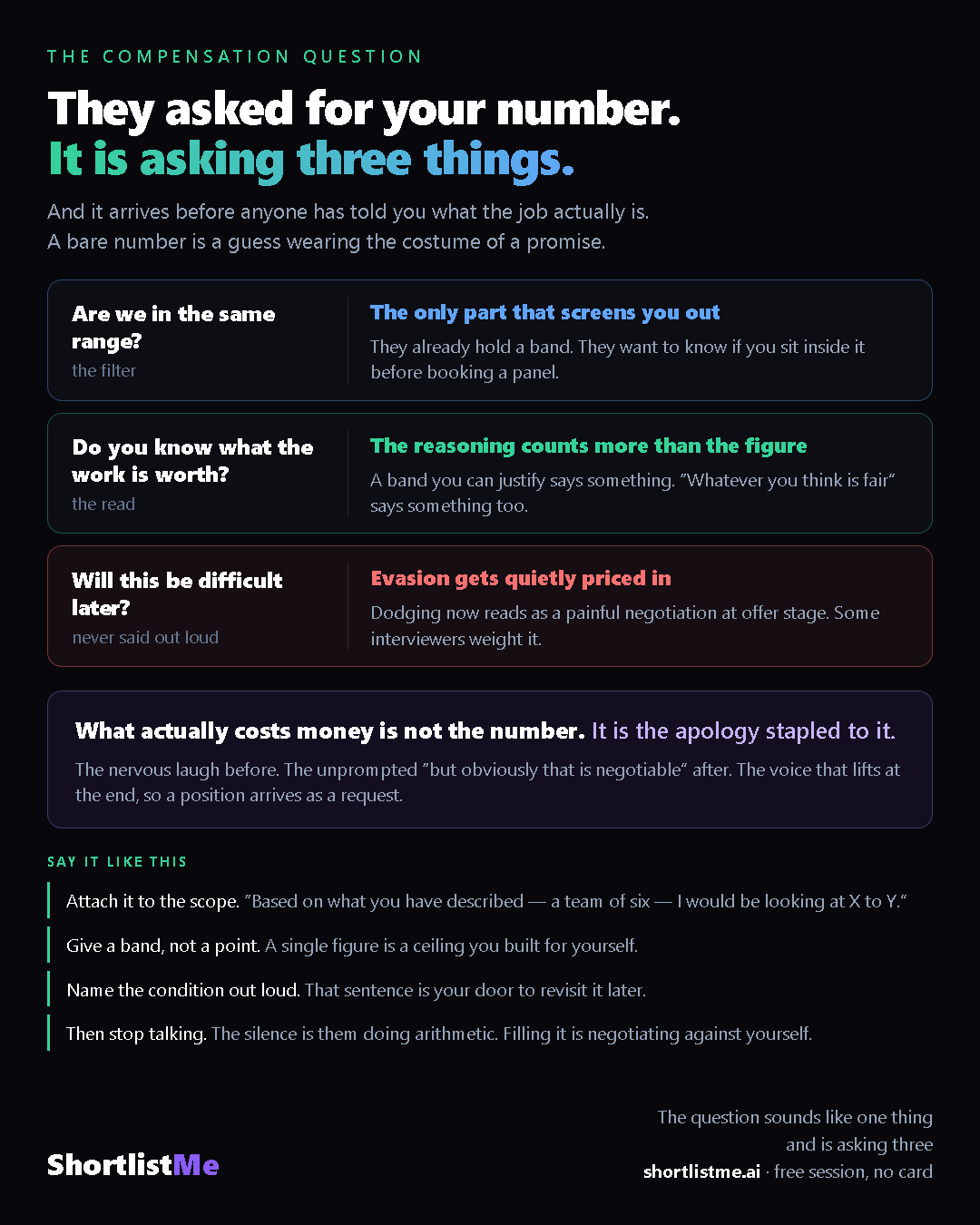
Three things, stacked.
Are we in the same range? They have a band. They want to know whether you sit inside it before anyone books a panel. This is the only part that is genuinely a filter.
Do you know what the work is worth? Not whether you will fight for it — whether you hold a considered view. Someone who names a range and can say why has revealed something about how they think. Someone who says "whatever you think is fair" has revealed something too.
Is this going to be difficult later? Nobody says this out loud. But evasion at this stage reads as a painful negotiation at offer stage, and some interviewers quietly price that in.
Answer the scope, then the number
The move is not to dodge. Dodging is what makes it awkward, and it buys very little — recruiters have heard every deflection and most will simply ask again, now slightly more alert.
The move is to attach the number to what you have been told, and make the attachment audible.
"Based on what you have described — a team of six, owning the migration end to end — I would be looking somewhere in the region of X to Y. If the scope turns out broader than that, I would want to revisit it. What have you budgeted for the role?"
That does four things in about twelve seconds. It gives them a usable band, so the filter clears. It shows the band is reasoned rather than plucked. It leaves you a legitimate door to move later, because you named the condition out loud instead of reserving it silently. And it hands the question back.
Then stop talking.
The part that actually costs money
Here is what I have watched happen more often than the number being wrong.
The number is fine. The band is well judged, defensible, appropriate to the market. And it is delivered with an apology stapled to it — a nervous laugh before, an unprompted "but obviously that is negotiable" after, a voice that rises at the end so the whole thing arrives as a request.
The words were a position. The delivery was a request for permission. The person on the other end responds to the second one.
This is not a mindset problem and you cannot fix it by deciding to feel more confident. It is a delivery problem, and delivery is physical: pace, pitch, and what you do in the two seconds after the sentence ends. Most people have never once said a salary figure about themselves out loud. The first time they hear it is in the room, with money resting on it.
Rehearse the sentence, not the theory
You can read about negotiation for a week and still hear your own voice wobble the first time you use any of it. The gap is not knowledge.
So do the small, faintly embarrassing thing. Say your range out loud. Record it on your phone. Play it back tomorrow, when you have forgotten what you meant and can only hear what you said.
Listen for three things. Did your pitch rise at the end. Did you add a softener nobody asked for. Did you fill the silence that followed, or let it sit.
That last one is the whole discipline. The silence after a number is not empty — it is the other person doing arithmetic. Filling it is how people negotiate against themselves, out loud, unprompted, and for free.
What this will not do
It will not move a band that is genuinely fixed. Plenty of roles carry a number set by a grade, a public-sector scale, or a budget signed off two quarters ago, and no phrasing gets past that. When you meet one, the useful thing is to find out early and decide whether the rest of the offer stands up on its own.
It will not make you immune to a lowball. It means that when one arrives, you are answering from a stated position rather than assembling one under pressure.
And it will not make the moment comfortable. For most people it stays slightly uncomfortable permanently. Comfort was never the goal. The goal is that the discomfort stops leaking into your voice.
ShortlistMe runs live voice interviews with an AI interviewer that asks real follow-ups, including the compensation question, and returns the full transcript afterwards. The first session is free and does not need a card.