You prepared. That is the part that stings.
You read the job description twice. You listed your projects. You thought through the awkward question — the gap, the reason you left, the thing on the CV you were hoping they would not open — and you worked out what you would say. Lying in bed the night before, you ran it. It was fine. It was better than fine, it was good.
Then you sat down, they asked it, and what came out was a shape you did not recognise. Longer. Vaguer. It doubled back on itself. Somewhere in the middle you heard yourself say "so yeah, that's kind of the situation" and you knew you had lost it.
Nothing went wrong in the room. It went wrong the night before, in a way that felt exactly like working.
Silent rehearsal feels like preparation because it removes the hard part
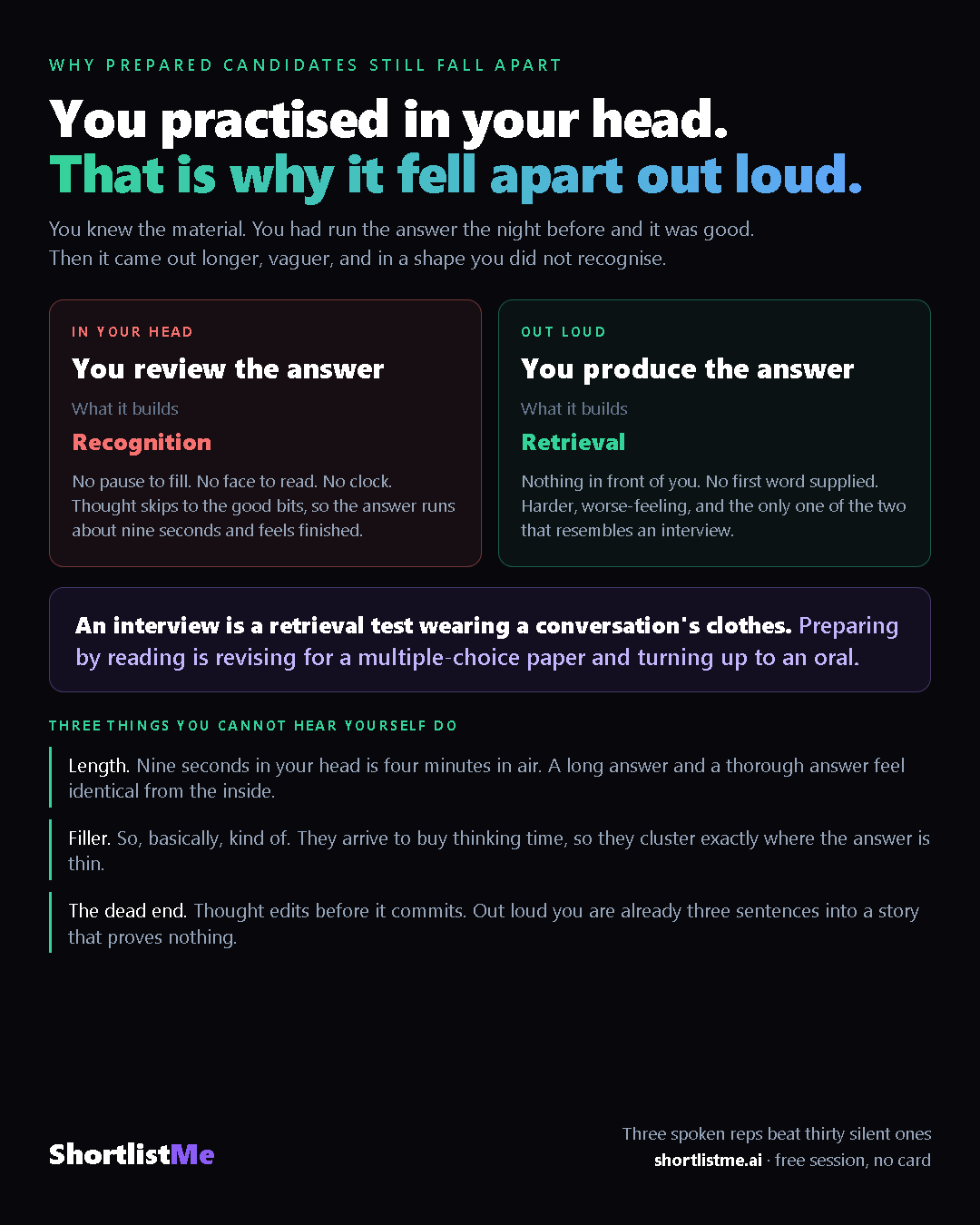
When you rehearse an answer in your head, you are not producing it. You are reviewing it.
There is no pause to fill, so you never fill one. There is no listener, so you never watch a face go blank and correct course. There is no clock, so the answer takes however long it takes — which in your head is about nine seconds, because thought skips. You do not internally narrate every clause. You jump to the good bits, land on the strong line, and feel the click of yes, that's the answer.
That click is real. It is just not evidence of what you think it is. It is evidence that you would recognise the right answer if you saw it. It says nothing about whether you can build it, out loud, at speed, from nothing, while a stranger waits.
Recognition and retrieval are different skills
This is the whole thing, so it is worth being precise about it.
Recognition is looking at material and knowing it. You reread your notes and every line lands as familiar. That familiarity is what makes silent revision so seductive — the sense of fluency rises with every pass, and it keeps rising long after your actual ability to produce the material has stopped improving.
Retrieval is generating the material with nothing in front of you. No notes, no prompt, no first word supplied. It is harder, it feels worse, and it is the only one of the two that resembles an interview.
An interview is a retrieval test wearing a conversation's clothes. Nobody hands you the paragraph. You get a question, a silence, and a face — and you have to assemble something from scratch while managing the silence and the face at the same time.
Preparing by reading is preparing for the wrong exam. You have revised for a multiple-choice paper and turned up to an oral.
The three things you cannot hear yourself do
Even setting the mechanism aside, silent practice is missing the data. There are failures that only exist in air, and you are structurally unable to detect them from the inside.
One: length. In your head, the answer is a summary. Out loud, it is a narration — you have to bridge between points, and bridges are where sentences go to die. The answer that ran nine seconds silently runs four minutes spoken, and you will not notice, because from the inside a long answer and a thorough answer feel identical. The interviewer stopped taking notes ninety seconds ago.
Two: filler. So, basically, kind of, if that makes sense, yeah. You do not hear these. They arrive to buy processing time, which means they cluster precisely around the parts you have not worked out. Someone listening hears exactly where your answer is thin, in real time, whether or not they could name what they are hearing.
Three: the dead end. You start a story, get three sentences in, and realise it does not actually demonstrate the thing you were asked about. In your head you never got there, because thought edits before it commits. Out loud you are already in the sentence, and now you have to land a plane you should not have taken off in. This is what most "I rambled" experiences actually are — not a rambling problem, a commitment problem.
None of these are knowledge failures. You knew the material. All three are production failures, and production is the thing you skipped.
Why the first time out loud is always the worst time
Every answer has a first spoken version, and it is always the roughest one. That is not a flaw in you. It is what a first draft is.
The only question is who gets to hear it.
Right now, for most people, the first spoken version of "tell me about the gap" happens in the interview that matters, in front of the person deciding. You are doing your rough draft live, once, at the highest possible stakes, with no second take. Then you do not get to hear it back, and the feedback — if it comes at all — is a two-line email three weeks later that explains nothing.
That is a genuinely terrible way to learn anything. If someone described that training loop for any other skill, you would laugh.
What actually changes, and how fast
The fix is unglamorous and it works quickly, because the gap you are closing is small and specific. You are not learning new material. You already have the material. You are moving it from recognition to retrieval, and that transfer is fast.
Say it out loud, once, badly, on purpose. The first rep exists to be bad. Its only job is to convert a vague intention into an actual spoken object with a real length and a real ending. You cannot fix a draft you have not written.
Record it and listen back once. Once is enough, and once is unpleasant. You are not listening for quality. You are listening for three things: where it got long, where the filler clustered, and where you started something you could not finish. Those three marks are your entire edit list.
Do it under a little pressure. Answering in your own time, at your own desk, when you feel ready, is still not the test. Some pressure — a timer, a question you have not seen, a person, anything that removes the option to restart — is what makes the practice transfer.
Then vary the question. Rehearsing one answer thirty times produces a monologue that survives exactly one question and collapses on the follow-up. What you want is the same material retrieved from different angles, so that what you have built is flexible rather than memorised.
Three or four spoken reps will beat thirty silent ones. Not because speaking is magic, but because it is the actual thing, and the actual thing is the only practice that counts.
The uncomfortable version of all this
The candidates who interview well are very often not the most capable candidates. They are the ones who have done this recently, and often — people who have been job-hunting a while, or whose networks include someone willing to sit across a table and ask.
If you stayed somewhere for six years and did excellent work, you have had almost no reps. You will walk into the room objectively better at the job and measurably worse at the interview, and the process will struggle to tell those two things apart.
That is not fair. It is also not going to change before your next interview. The only part of it you control is how many times you have said the words out loud before the words have to count.
Say them somewhere cheap first.
ShortlistMe exists for exactly this: spoken practice with an interviewer that asks follow-ups, waits while you think, and gives the answer back so you can hear what the room heard. The first session is free and does not need a card.