There is a kind of rejection that makes no sense from the inside.
You knew the material. You answered everything. You were not stuck, you did not blank, and you left the call thinking it had gone reasonably well. The feedback, if any arrives, says something about going with a stronger communicator — which lands as unfair, because you communicated plenty. You communicated for eleven minutes.
That is the problem. Not that you said the wrong thing. That you said the right thing, and then kept going.
What is happening on the other side of the call
The same answer, from the interviewer's chair.
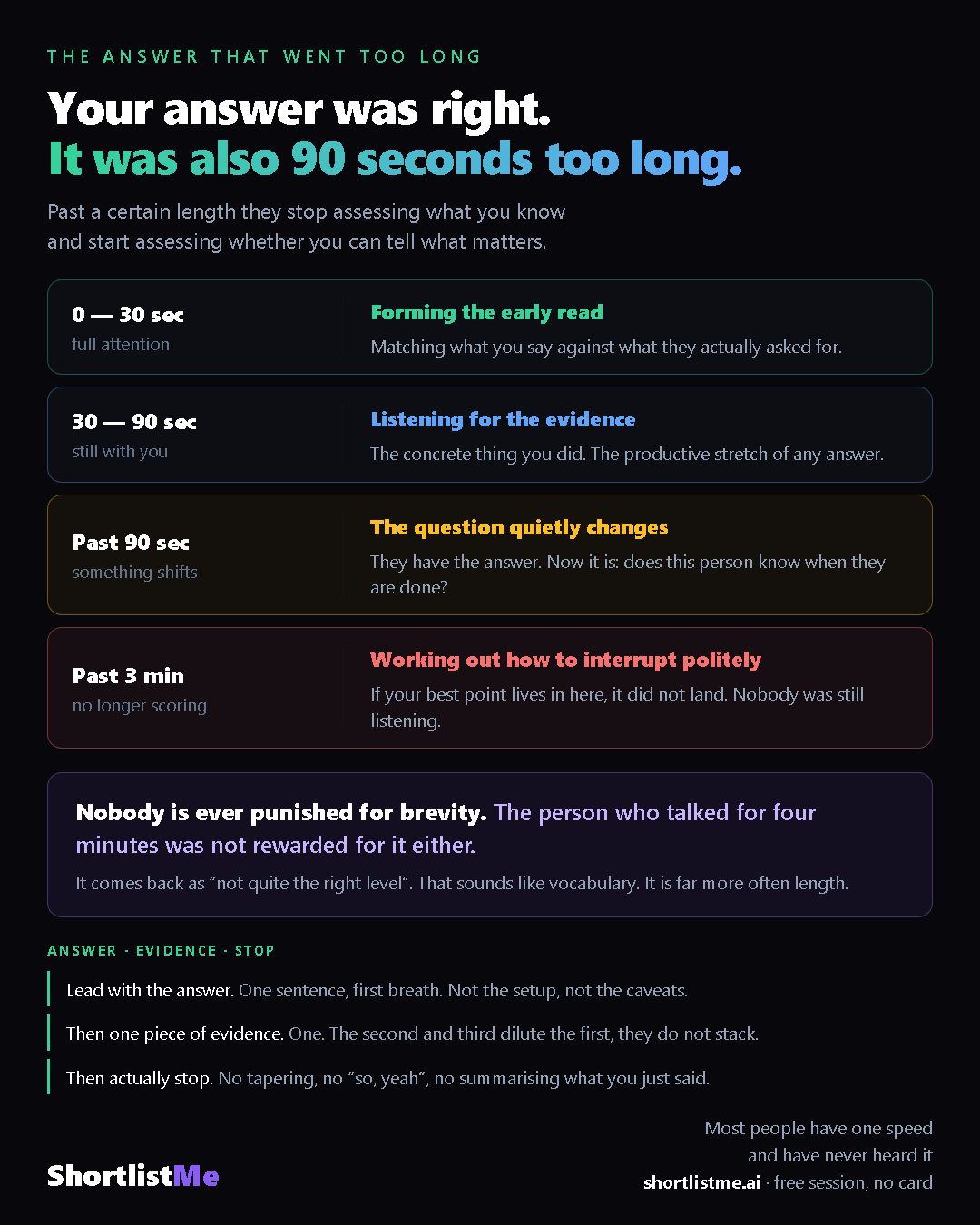
First thirty seconds. Full attention. They are matching what you say against what they asked and forming an early read.
Thirty to ninety. Still with you, now listening for the specific evidence. This is the productive stretch of most answers — the concrete thing you actually did.
Past ninety. Something quietly shifts. They have the answer. You are still talking. So the question in their head stops being does this person know it and becomes does this person know when they are done.
That second question decides senior hires. Nobody writes it on a scorecard. It comes out as "not quite the right level," and it is far more often about length than about vocabulary.
Past three minutes. They have stopped weighing the content and started working out how to interrupt you politely. Nothing said in this stretch is being scored. If your best point lives here, it did not land.
Why capable people do this
Almost never arrogance. Usually one of three things.
Silence feels like failure. Two seconds of quiet in a normal conversation is nothing. Two seconds in an interview feels like a minute, and the instinct is to fill it. So you keep talking past the end of your own point, and the filler goes into the record next to the substance.
You are finding the point while talking. You had not decided what the answer was before you started, so you are searching in real time. The first ninety seconds is the search. The actual answer arrives at the end, if it arrives, by which time it is landing on someone who stopped taking notes.
You are trying to be thorough. This is the honest one, and the most common among technical people. You know there are five caveats. Leaving them out feels like lying. So you deliver all five, and what would read as rigour on paper reads out loud as an inability to prioritise.
That instinct is not wrong. It is misplaced. The caveats are what the follow-up question is for.
Answer, evidence, stop
The structure that survives contact is unglamorous.
Lead with the answer. One sentence, first. Not the context, not the setup, not "there are a few ways to think about this." The actual answer, in the first breath. If they hear only one sentence, that is the one that has to carry it.
Then one piece of evidence. A specific thing you did, with a number attached if you have one. One. Not three. The second and third are not more convincing than the first; they dilute it.
Then stop. Actually stop. Do not taper, do not add "so, yeah," do not summarise what you just said. Finish the sentence and let it sit.
Sixty to ninety seconds covers this comfortably for most questions.
The silence is doing work
When you stop, one of two things happens, and both are good.
They ask a follow-up. This is the best outcome available to you. It means they are engaged, and — more usefully — it tells you exactly which part they cared about. You now get to go deep on the thing that actually matters to them, instead of spreading across five topics and hoping one connects. Those caveats you were going to volunteer? Deploy the relevant one now, to someone who has just asked for it.
Or they move on. Also fine. It means the answer was sufficient, which is what sufficient is supposed to feel like.
What does not happen is that they punish you for brevity and reward the person who talked for four minutes.
How to find your own line
You cannot judge your own length while speaking. Time distorts under adrenaline — ninety seconds feels like twenty. This is why "be more concise" is useless as advice on its own. You already agree with it. You still cannot feel it happening.
So measure it instead of estimating it.
Record yourself answering one real question, unprepared, as you actually would. Then guess the length before you look. Most people are out by a factor of two, and the size of that gap is the finding.
Then listen back with an eye on the clock and mark the moment you finished answering — not the moment you stopped talking. Those are rarely the same moment, and the distance between them is your problem, in seconds.
Then run it again and try to land under ninety. It will feel abrupt and unfinished. That feeling is not a reliable signal. It is what appropriate length feels like from the inside when you are used to overshooting.
Where this does not apply
Some questions genuinely want four minutes. Walk me through the architecture. Take me through the incident end to end. Design this system. Cutting those to ninety seconds reads as thin, not sharp.
The structure still holds — headline first, then depth — but the budget is different, and the skill is telling the two kinds apart. A rough test: if they asked what or whether, it is short. If they asked how or walk me through, they have booked the time deliberately.
The point was never a stopwatch. It is that most people have exactly one speed, have never heard it, and find out what it costs from a rejection email that does not explain itself.
ShortlistMe runs live voice interviews with an AI interviewer that asks real follow-ups, and returns the full transcript so you can see where your answers actually ended. The first session is free and does not need a card.