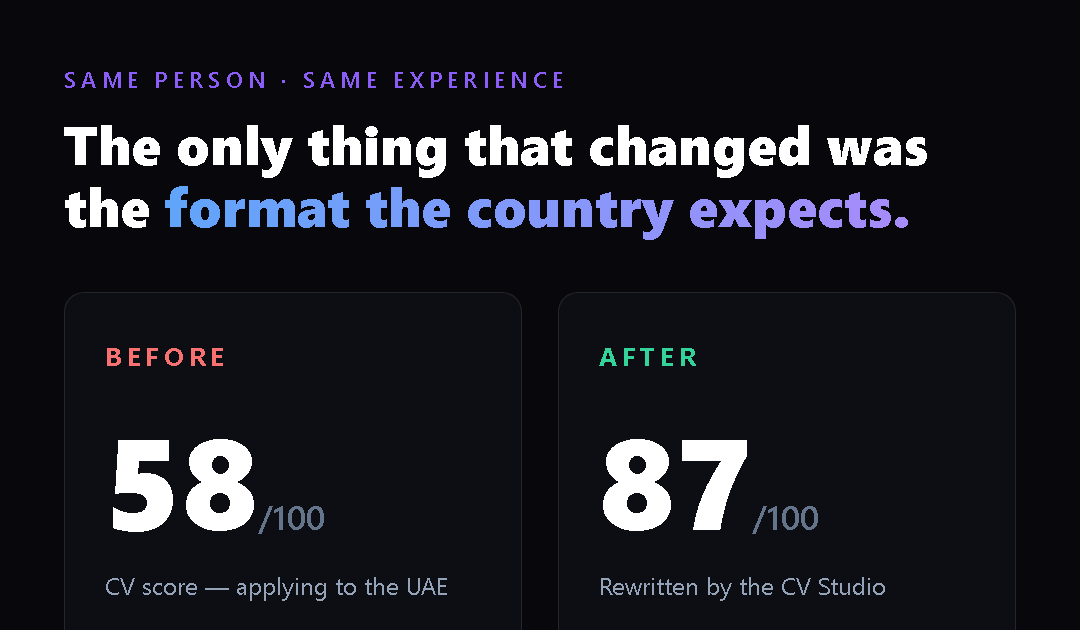
You send the application. Then nothing.
Not a rejection — those at least tell you something. Silence. A week, then two, and eventually you stop refreshing the inbox and quietly conclude the obvious thing: you weren't good enough.
That conclusion is usually wrong, and it is expensive, because it sends you off to fix the wrong problem. You go and collect another certification when the actual issue was that your CV had a photograph on it.
A CV is a local document pretending to be a universal one
Think about how you write a date. 03/04/2026. In London that is the third of April. In Chicago it is the fourth of March. Same characters, same order, completely different meaning — and nobody involved thinks they are using a regional convention. They just think they are writing the date.
CVs work exactly like that, except the stakes are your rent.
The Lebenslauf is the German-language CV: strictly reverse-chronological, with clear month-and-year ranges, and conventionally carrying a professional photo and a date of birth. Those last two are not padding or vanity. They are what a complete, serious document looks like in that market, and leaving them off can read as though you are hiding something.
Now send that same file to a US employer. American resumes omit photo, age, date of birth, marital status and nationality — not by taste, but because US hiring practice is built to keep protected characteristics out of the screening decision. The US Equal Employment Opportunity Commission is direct about the photograph in particular: employers "should not ask for a photograph of an applicant," and where one is needed for identification it should be requested only after an offer has been made and accepted (EEOC, Pre-Employment Inquiries and Race).
So your complete, professional, entirely appropriate German CV now hands a US recruiter something their process is designed not to receive — before anyone has looked at what you can do.
Neither document is wrong. They are answers to different questions.
What each market actually expects
This is the table I wish someone had handed me years ago.
| Market | Distinctive expectation | Leave out | Typical length |
|---|---|---|---|
| United States | Action verbs, quantified achievements, Letter page size | Photo, age, DOB, marital status, nationality | 1 page early career, 2 max |
| Canada | Canadian spelling; work authorisation only if you actually stated it | Photo, age, marital status | 1–2 pages |
| UK / Ireland | Opens with a Personal Statement; British spelling (organise, specialised) | Photo, age, marital status | 2 pages |
| Germany / Austria / Switzerland | Strictly reverse-chronological with month/year ranges | — | 2 pages |
| Europe (general) | A Languages section using recognised proficiency levels | Marital status | 2 pages |
| Australia / New Zealand | Australian spelling; commonly closes with "Referees available on request" | Photo, age, DOB, marital status | up to 3 pages |
| Gulf / Middle East | Personal Details block: nationality, visa status, languages | — | 2 pages |
| India / Pakistan / Bangladesh / Sri Lanka | Short Personal Details block; academic credentials placed prominently | — | 2 pages |
In Germany and the Gulf a photo is conventional. In the US, Canada, the UK and Australia it is not. That single binary decision is made wrong constantly by people applying across borders, and it stays invisible to them — their CV looks completely normal to everyone they know.
Where this table comes from. These are the same conventions the ShortlistMe CV Studio encodes for each market: section order, which personal details belong, page size and spelling. Several rows are backed by official guidance rather than folklore — the UK's National Careers Service tells applicants not to include age, date of birth, marital status or nationality (National Careers Service, How to write a CV), and Services Australia advises leaving date of birth off an Australian résumé altogether (Services Australia, Looking for work and job hunting).
The rest describe prevailing convention, not law — and conventions move. Germany is the clearest example: the photo remains common, but the country's Federal Anti-Discrimination Agency ran a national pilot of depersonalised application procedures precisely because photos and personal details carry discrimination risk (Antidiskriminierungsstelle des Bundes, Depersonalised application procedures). Treat the table as a strong default, then check it against two or three live job ads in your target market before you send anything.
One term worth defining, because it decides whether any of this is read at all. An applicant tracking system (ATS) is the software that parses your CV into structured fields — name, roles, dates, skills — before a human opens it. Multi-column layouts, text inside images, tables and header/footer contact details are the usual things it silently fails to read. A CV that looks beautiful and parses badly loses to a plain one that parses cleanly.
The three that cost people the most
The photo. Covered above, and it is the one I see most often. If you are applying to the US, the UK, Canada, Australia or New Zealand, take it off. If you are applying in Germany or the Gulf, it usually belongs.
Duties where outcomes belong. "Responsible for network operations" tells a reader what you were assigned. "Cut outage time 40% across 14 sites" tells them what happened because you were there. One of those survives a skim; the other does not. Go through your CV and count how many lines contain a number. If the answer is zero, that is the highest-return hour of work available to you this week.
Spelling. Organise or organize, specialised or specialized, centre or center. It is a small thing that quietly signals whether you have understood where you are applying. Match the market.
The part nobody tells you
Here is what makes this so persistent: the feedback loop is broken by design.
A rejection email does not say "wrong page size, remove the date of birth." It says nothing at all, or it says the position has been filled. So the only signal you ever receive is silence, and silence is a Rorschach test — you read your own worst assumption into it.
Every person I have watched hit this was qualified. Not one of them was underqualified. They were invisible, which looks identical from the inside and is a completely different problem.
And it is a formatting mismatch. It takes about ten minutes to correct once someone points at it.
What to do this week
You do not need any product for these.
- Name your target market. Not "abroad" — the actual country. Then find what a CV looks like there. A recruiter in that market, a friend who works there, an official careers service; ten minutes of looking beats another month of applying blind.
- Strip or add the personal block deliberately. Photo, date of birth, nationality, marital status: each of those is either expected or disqualifying depending on where the file is going. Decide on purpose instead of by default.
- Put numbers on your last three roles. Replace every "responsible for" with something measurable. If you cannot measure it, you have probably described the task rather than the outcome.
- Set your spelling to the market and check your page length against the table above.
What we built
The CV Studio inside ShortlistMe does this part automatically. It reads your CV, works out the conventions of the country you are targeting, and rewrites it to match — section order, which personal details belong, page size, spelling, and an ATS-readable structure rather than a design-led template that parsers choke on. It scores the result and tells you what it changed and why.
It is free to start: two CV analyses, no card.
What it will not do is promise you a job. Nobody can promise that, so I don't. What it can do is make sure that when your CV is read, it is read as a local document — and that the silence you get back, if you get silence, is at least about you and not about your page size.
If you are applying across borders right now and something above landed, write to me at info@shortlistme.ai and tell me which country you are targeting.
— Muhammad Waqar, Melbourne
Sources
- U.S. Equal Employment Opportunity Commission — Pre-Employment Inquiries and Race. Employers should not request a photograph before an offer is made and accepted.
- National Careers Service (UK) — How to write a CV. Do not include age, date of birth, marital status or nationality.
- Services Australia — Looking for work and job hunting. Keep date of birth and home address off your résumé.
- Antidiskriminierungsstelle des Bundes — Depersonalised application procedures: summary of outcomes. German federal pilot removing photos and personal details from applications to reduce discrimination.
Country conventions not covered by the sources above reflect the market templates the ShortlistMe CV Studio applies, and describe common practice rather than legal requirement.